The
Griptape
The cheapest part of a skateboard and the only one you actually stand on. Griptape — the sandpaper-like sheet stuck to the top of the deck — decides whether your feet stay where you put them, how the board answers a flick, and how quickly your shoes fall apart. Two things describe a sheet: how big the abrasive grain is, and what that grain is made of. They are independent, almost nobody separates them, and the codes on the label — 80AB, OS780, HS780 — encode one in the number and the other in the letters.
What a sheet of griptape is
Five materials stacked a fraction of a millimetre thick, and each of them is a way the sheet can fail.
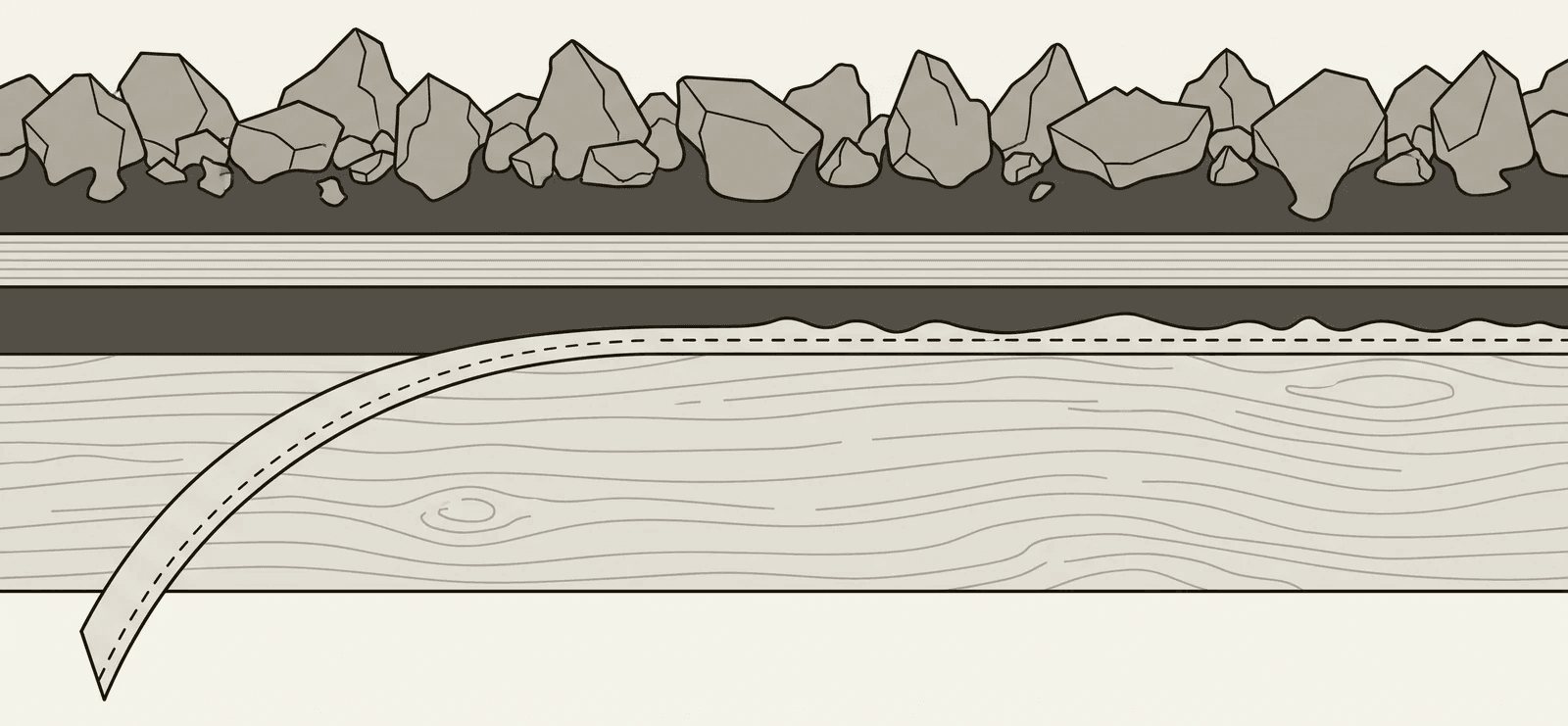
The grain
The abrasive itself — crushed mineral, sorted by size, standing proud of the surface. This is the only part of the sheet that touches your shoe, and how big these particles are and what mineral they are cut from is the whole of what makes one tape different from another.
- Made of
- Silicon carbide, aluminium oxide, or both
- Sized by
- Grit number — lower is coarser
- Fails by
- Rounding over until it stops cutting
Grit — and why a smaller number means rougher
Grit counts how many grains fit in a given space, so a low number means few large grains and a high number means many small ones. Low is coarse. It reads backwards to almost everyone the first time — and skateboard grip has one grade that breaks the pattern outright.
Grain size at relative scale — low numbers are coarse, high numbers are fine.
80 grit
The skateboard number. Street, park, vert and essentially every popsicle board sold anywhere. If a sheet does not say what it is, it is this. Fine enough that you can slide a foot into position without picking it up, coarse enough to hold that foot through a landing. The fact that an entire sport converged on one grade is a reasonably strong argument that it is the right one.
780 is a grit, and the letters are not. Every grip tape code is a number and a prefix doing two different jobs. The number is the grain. 60 is coarse, 80 is the street standard, and 780 — despite reading like a very fine paper — is a blend of size 70 and 80 crystals, which our manufacturer calls the most-used grade for pro grip tape. It sits right beside 80 on the scale, which is the opposite of where the number suggests. The letters are the abrasive and the glue, and they are what separate one 780 sheet from another.
- The numberGrain size
- 60, 80, or 780. Lower is coarser, and 780 is the odd one out: a mix of 70 and 80 crystals, which is why it lands beside 80 instead of far above it. Our OS780 and HS780 are both in the 80-grit class — the same grain in both sheets.
- ABAbrasive
- The budget grade. Dark black tape, the grade that goes on entry-level completes rather than being sold to people replacing a sheet by choice. 80AB is 80 grit in this grade.
- SSilicon carbide
- Straight silicon carbide, the standard good material. 80S is 80 grit in plain silicon carbide.
- OSOil glue and crystals
- The professional-grade combination our standard sheet uses. OS780 and OS60 are the same grade at two different grain sizes.
- HSHigh-level silicon carbide
- The best abrasive in the range and the most expensive to make. HS780 is the same grain as OS780 in a better material — which is the whole of the difference between our two sheets.
Naming conventions from 2HEX, who manufacture grip tape. Codes vary between factories; these are the ones behind the sheets we sell. A factory taking a grip order asks three questions — what grit, what glue, what print — and those three answers are the whole specification.
What the grain is made of
The second variable, and the one nobody prints on the sheet. Two grains of identical size made of different minerals do not grip the same, do not last the same, and do not cost your shoes the same.
Silicon carbideSharper
The harder and sharper of the two, with angular grains that bite rather than rub. It is also the more brittle: under load the grains microfracture, and each fracture leaves a fresh edge behind. A silicon carbide sheet therefore keeps cutting as it wears — it loses material instead of going smooth. That is why it is the standard for street and park tape, and why it goes through shoes. The grain that holds your foot on a ledge is holding onto your suede with the same enthusiasm.
Aluminium oxideTougher
Less sharp, but the individual grains are tougher and survive longer before breaking. Instead of fracturing into new edges it tends to round over, so the sheet wears evenly and gently and gradually feels less like it is gripping and more like it is just rough. Kinder to shoes, more consistent over its life, and the usual choice where the tape is doing a safety job — stair treads, ramps, walkways. On a skateboard it turns up blended into finer grades.
- The trade, in one lineThere is no better grain
- Silicon carbide gives you more bite and spends itself and your shoes doing it. Aluminium oxide gives you less bite and lasts longer being less useful. Which one is right depends entirely on whether you need the board to hold a foot through a flip trick or simply need to not slip off it.
- Why sharp beats hardFriability
- Hardness decides whether a grain can cut. Friability — how readily it breaks — decides whether it goes on cutting. A grain that never breaks eventually polishes smooth and stops working while still physically there, which is why a worn sheet can look perfectly intact and grip like glass.
- Blends existAs a way of tuning
- Plenty of tape is made with both minerals in the coating. It is a way of tuning how quickly a sheet gives up its bite. Our budget grade is a blend; both our 780 sheets are silicon carbide, one a higher grade of it than the other.
- What holds it onThe resin bond
- The grain is glued to the backing with resin, in a coat that has to be thick enough to hold and thin enough to leave the sharp tips proud. Cheap tape gives itself away here: grain that sheds onto your hand the first time you press it down was never properly bonded, and that sheet will go bald in patches.
80AB, OS780 and HS780
Three sheets, and only two grain sizes between them: reading the codes is most of the work.
| Spec | 80ABBudget grade | OS780Standard | HS780Best material |
|---|---|---|---|
| Grain size | 80 grit | 780 — a 70/80 blend | 780 — the same as OS780 |
| Abrasive grade | AB — the budget abrasive | OS — oil glue and crystals, professional grade | HS — high-level silicon carbide, the best in the range |
| What differs | 80AB is a step down in both grain and material. OS780 and HS780 differ only in the abrasive — same grain, better mineral. | Holds its edge longer and bites harder for it | |
| How it feels | Grips without shouting about it. You can shuffle a foot into position rather than having to lift it. | The default. Firm enough that your feet stay put, loose enough to move them mid-line. | Sharper under the same foot, and stays sharper. You place a foot once and it stays there. |
| Best for | Learning, cruising, anyone who does not want their shoes destroyed in a month | Almost everybody, almost all of the time | Skating in heat, sweaty feet, and anyone who wants no doubt about where their back foot is |
| Shoe wear | Slowest of the three | Normal | Noticeably faster |
| Sheet | Pre-cut and applied at the factory | 9″ × 33″ — 22.8 × 83.8cm | 9″ × 33″ — 22.8 × 83.8cm |
| How you get it | Fitted to beginner completes. Not sold on its own | Sold as a sheet | Sold as a sheet |
HS780 has the same grain as OS780. The 'extra grip' sheet sounds like it should have a bigger one, and both are 780, in the 80-grit class. What HS780 has is a better abrasive: a higher grade of silicon carbide that starts sharper and keeps its edge longer under the same foot. So the choice comes down to how long you want the bite to last and how fast you are willing to go through shoes to have it. Plenty of people who skate very well prefer the standard sheet.
Applying a sheet without ruining it
Re-gripping is the first repair most skaters do themselves, it takes about ten minutes, and almost every way it goes wrong is decided before the sheet touches the wood.
A blade
A fresh craft or utility blade. A blunt one tears the backing and leaves a ragged edge that starts lifting within a week.
A file or screwdriver
Anything with a hard straight edge, to score the outline. A flat file is best; a screwdriver shaft works.
Something to poke with
A nail, a bradawl, a thin screwdriver — for finding the eight bolt holes from underneath.
The backing paper
Don't throw it away. It is the pad you press through, and it stops your palm shredding.
Clean the deck
Wipe the top of the deck and let it dry properly. On a new deck that means getting the dust off; on a re-grip it means getting every scrap of old adhesive off, because the new sheet will bond to residue rather than to wood and lift early. If you are pulling an old sheet, warm it with a hairdryer until the adhesive lets go and peel it back from a corner rather than tearing at it.
A deck that feels clean and looks clean can still have a fine film of dust on it. Run a dry cloth over it once more than you think you need to — this is where most lifted edges are created.
Griptape in Indian conditions
Grip is the part of a skateboard most affected by where you skate, and almost every piece of advice written about it was written for somewhere cooler and cleaner than here.
Heat
Sweat beats fine grain
A damp sole and a fine grain is the combination that slips. The moisture fills the space between the grains and your shoe starts riding on a film instead of biting into the sheet. It is the single best argument for the sharpest abrasive you can get, and the reason our HS780 sheet exists. Heat works on the adhesive as well. It is a pressure-sensitive glue and it softens as it warms; a board left in a parked car or lying in the sun gets far hotter than the air around it. Softened adhesive does not fail on its own, but it will happily let an edge that has already started lifting carry on lifting. It is the same property you exploit deliberately when you take an old sheet off with a hairdryer.
Dust
Dirt reads as wear
Fine dust packs into the gaps between grains until the surface feels smooth. It reads exactly like a dead sheet while the grain underneath is still sharp, just buried. This is the most common reason people re-grip a perfectly good sheet. Tell them apart with a stiff dry brush. If a minute of scrubbing brings the bite back, it was dirt. If the sheet still feels polished under the dust, the grain has rounded over and no amount of cleaning will fix it.
Monsoon
The tape survives, the deck doesn't
Water does very little to the grain or the backing. What it does is get in at the cut edge and at the bolt holes, and then sit there — the sheet is effectively a lid holding moisture against end grain. Maple swells, the plies start to separate, and the board goes soft long before the grip looks worn. So the rule is about drying. Stand a wet board on its tail so the water runs off, dry it in shade, and get the water out of the bolt holes. A neatly cut edge helps here too: a ragged one is a wick.
The water-and-maple half of this is a deck problem, and the deck guide covers what moisture does to a seven-ply once it gets in.
Open the deck guide →How griptape dies
Five ways, and only three of them are the end of the sheet. Knowing which one you are looking at saves you a sheet more often than not.
Polished patches
TerminalTwo shiny areas where your feet live — over the front bolts and on the tail. The grain there has rounded off and stopped cutting. It is the normal way a sheet ends its life, it is not repairable, and it is dangerous in exactly the place you need grip most, because the tail patch is where your foot goes to pop.
There is no schedule. A sheet can last a couple of months of daily skating or well over a year of weekends, and the variable that matters most is how much of your skating happens on the same two patches. Slides, ledges and bail marks wear the middle; flatground wears the tail. Re-grip when the tail stops holding your foot. And re-grip before concluding the board is finished: a smoothed sheet makes a deck feel dead, and a great many boards get replaced when what they needed was a sheet of tape.
The range
Two sheets of our own, one grade you only get fitted, and a shelf of other people's tape because not everybody wants black.
 Sphere Original OS780Standard grip. 9″ × 33″
 Sphere Heavy HS780Extra grip. 9″ × 33″
 Wasted Angels × Mon AmourPrinted collaboration on the OS780 base
 Shake JuntDistributed by WeSkate Co.
Product photography. Grain size and abrasive are not visible at this scale — the drawings above are where those live.
| Sheet | Ours (Sphere) | Everything else (Distributed) |
|---|---|---|
| Sold as a sheet | OS780 and HS780, both black, both 9″ × 33″ (22.8 × 83.8cm) | Shake Junt, including pro-model sheets. Same 9″ × 33″ |
| Fitted only | 80AB fine, on beginner completes. Not sold separately | — |
| Graphic sheets | Printed collaborations on the OS780 base, in runs rather than as a permanent line | Coloured and printed sheets from the brands we carry |
| Grain | Both sheets are 780 (80-grit class). OS780 is professional-grade, HS780 is the higher grade of silicon carbide | Varies by brand — most street tape is silicon carbide. The Shake Junt sheets feel like an OS780 to us |
| Fits | Any deck up to 9″ wide, which is the whole of our nine-width range — though on the widest deck it is very nearly edge to edge | |
Names you will see and we don't make. Mob, Jessup and Grizzly come up constantly in videos and forums, and none of them are stocked here. Treat them as reference points: Mob is the byword for coarse and perforated, Jessup for a gentler classic feel. If a video tells you to use one of them, what it is telling you is roughly where on the coarse-to-fine axis that skater sits.
On the imported sheets, since we sell both. Our read, having used them: the Shake Junt tape feels like an OS780 — same class of grain, same kind of bite, wearing much the same way. That is a judgement made with our feet, and someone who skates more than we do might well separate them. The extra you pay for the import buys the graphic, the pro model and the name on it. The grip comes out the same. Those are fair reasons to buy one, and we stock them for that reason. If what you want is grip, the standard sheet does it.
Grip is the one part of a build where the choice is about preference rather than sizing. If you are picking the rest of a setup, start with the deck.
Open the configurator →Straight answers
True for any griptape from any brand. What we happen to stock is at the end of each one.
You can, and it is the most common shortcut in skateboarding, but it costs you something every time. The new sheet is bonding to the old backing rather than to wood, so it holds less well and lifts sooner. You also add thickness, which rounds off the feel of the concave under your feet — two or three layers deep and the board rides differently.
The right way takes ten more minutes. Warm the old sheet with a hairdryer until the adhesive gives up, peel it from one corner, and take the residue off with a bit of heat and a rag. For the patches that will not shift, nail-polish remover on a cloth softens the glue and lets you scrape it away — work it gently and keep it off the graphic on the underside. A heat gun does the heating faster and will scorch the wood if you are careless, so a hairdryer is the better tool for a first attempt.
One case where layering is fine: a small patch over a torn area, as a repair, on a board you are going to re-grip properly anyway.
Sheets in standard and coarse, sized to cover any deck we make.
Start dry. A stiff brush — a nail brush, a suede brush, an old toothbrush for the corners — and a minute of scrubbing gets most of what is in there out, and on dusty ground that is usually the whole problem. Brush along the board rather than in circles so the dirt travels to the edge instead of moving around.
For the ground-in stuff there is grip gum: a block of soft rubber that you rub across the sheet, which balls up and lifts dirt out of the grain. A clean pencil eraser does a smaller version of the same job. Neither will recover a sheet whose grain has actually rounded over.
Keep water out of it. A damp cloth over the surface is survivable; soaking the board is not, because the water goes through the bolt holes and the cut edge into the ply and stays there. If the sheet is dirty enough to need washing, it is cheaper to re-grip than to replace a deck.
No cleaning products — a brush you already own does the job.
Yes, and it is the abrasive doing exactly what it is designed to do. The grain that holds your foot in place during an ollie is dragging across the side of your shoe every time you flick, and the ollie itself — dragging the toe up the board — is the single most destructive thing you can do to a shoe. Suede lasts longer than canvas, and a toe cap of any kind lasts longer than neither.
Coarser grain wears shoes faster, so the trade is: the tape that holds your foot best is the tape that costs you most in shoes. A fine grade slows it down, which is why it is the sensible default for someone learning, who is going to be dragging a toe up the board several hundred times a day and is not yet doing anything that needs maximum bite.
What does not work is riding on the graphic or leaving a patch ungripped — you lose grip exactly where you need it. Shoe goo on the wear point before it becomes a hole works far better than anything you can do to the board.
Our HS780 sheet carries the warning on its own product page. Beginner completes ship on 80AB, the gentlest of the three.
Almost always one of three things, and all of them happened during application. The edge was cut with a blunt blade and left ragged, so there was a loose fibre for a shoe to catch. The deck was dusty or oily where the sheet went down, so the adhesive never made full contact. Or the nose and tail — the parts that curve most — were not pressed down hard enough, because a sheet bridging a kick is under tension and wants to spring back.
Caught early, press it back down firmly and it will usually take. A little heat from a hairdryer softens the adhesive and makes that more likely to hold. Once the flap is big enough to get a fingernail under, dirt has been getting in behind it and it is not going to re-bond.
Prevention is in the application: clean deck, sharp blade, and press the kicks down properly with your thumb rather than your palm.
Sheets only — a fresh blade from any hardware shop is the other half of the job.
It depends entirely on how it was printed, and there are three methods with different consequences.
Silk screen lays ink thickly enough that it fills in between the grains, so it measurably costs you grip across whatever it covers. It is fine for a small logo and a bad idea for a full-sheet design. UV printing puts the ink down thin enough that a sheet can be covered completely without the grip suffering, which is why full-coverage graphics are usually UV. Digital printing sidesteps the problem: the design goes on a white backing underneath a transparent abrasive, so it reads as though it is printed on the surface while the grain stays untouched.
So the process decides it: a silk-screened sheet does lose grip, while a UV or digital one largely keeps it. If a sheet is covered edge to edge in artwork and still bites properly, that tells you which process was used.
Die-cut designs — shapes cut out of the sheet so the deck shows through, in patterns with names of their own like speedstripe, mosaic and barcode — are a separate matter. You lose grip wherever the cut-out is, and the cut edges are extra places for a sheet to start lifting. Both matter most under your back foot.
Plain black in both grades, plus printed collaborations and the coloured sheets from the brands we distribute.
Tape with fine holes punched through the sheet, so that air trapped underneath during application has somewhere to escape instead of forming a bubble. It is an application convenience: it makes no difference to how the sheet grips or how long it lasts.
It helps most on wide boards and on long sheets, where there is more area for air to get caught under, and it helps a first-timer more than someone who has done it twenty times. If your sheet is not perforated, the technique does the same job: lay it from one end, and press from the centre outwards so the air is always being pushed towards an edge.
A bubble you missed is easily fixed. Prick it at the edge of the bubble with a pin and press the air out towards the hole — poking the middle leaves a visible dimple.
We don't currently specify perforation either way on our sheets — assume not and use the technique.
Less than deck width and far less than concave, but more than people expect in one specific place: the tail. Everything you do on a skateboard that involves popping starts with a foot finding the tail without looking, and how confidently it locks there is a grip question. That is why people who have skated for years often have strong, seemingly disproportionate opinions about tape.
Everywhere else it can only take away. Grip that is too fine lets your foot creep out of position under load. Grip that is too coarse makes it hard to shift a foot into position at all, which matters more than it sounds if you are still learning where your feet go. Neither makes the board turn, pop or roll differently.
The practical version: if you never think about your grip, it is correct. It is the only part of a skateboard for which that is a complete test.
OS780 as the default and HS780 for people who have decided they want a sharper abrasive that lasts longer.