
Skateboard
Buying Guide
New to skateboarding, upgrading a setup, or buying for someone else? Answer four questions and walk away with the four numbers that decide how a board rides: deck width (how wide the board is), concave (how curved it is), truck width and wheel diameter.
Find your board
Four questions. We'll turn the answers into the four numbers that decide how the board rides.
Who is the board for?
This sets how forgiving the setup needs to be.
Anatomy of a complete skateboard
Six parts, numbered. Tap a marker to see what it does.
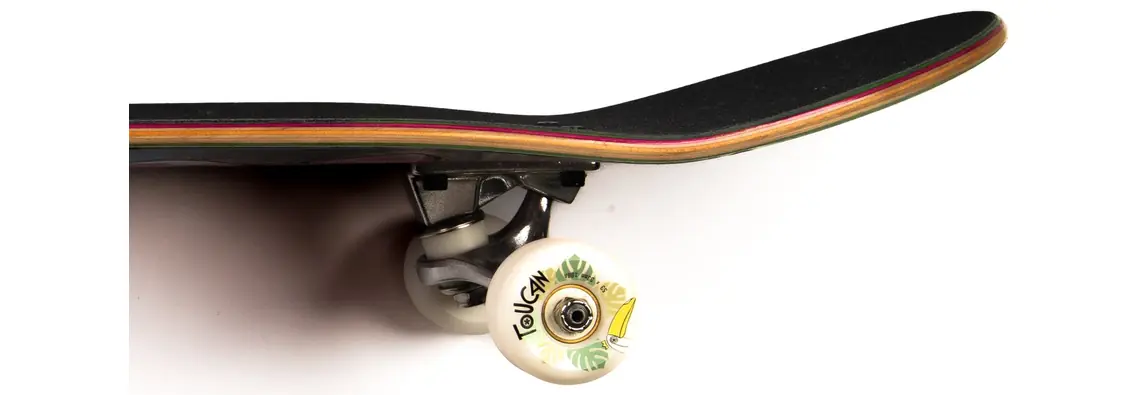
The same board edge-on: griptape along the top, the seven-ply stack in the edge, and the nose kick rising at the right.
Deck
Those coloured stripes in the edge are the seven plies of maple, cold-pressed with epoxy into a double kick popsicle — the standard modern shape, with an upturned kick at both ends so the board works either way round. The curve rising at the right is the nose kick, the leverage an ollie is levered off. Two numbers describe a deck: width, which follows your feet, and concave — the dish across the board. Mellow is flatter and easier to stand on; Medium digs deeper and gives your flick — the sideways kick that spins the board — something to push against.
- Construction
- 7-ply 100% Canadian maple
- Press
- Cold-pressed, epoxy
- Shape
- Double kick popsicle
- Concave
- Mellow, Medium
- Coming
- Mellow-Medium
- Not stocked
- Deep
- Widths
- 7″ → 8.875″, nine steps
- Stain
- 1-4-7 or 1-2-4-7 plies
What size deck should I get?
Width follows the foot. Pick your shoe size band.
The busiest range we sell, and 8″ is the most common street width in India — it is what most riders here land on and stay on. 7.75″ flips a little quicker if you are light on your feet; 8.125″ exists for riders who find 8″ a fraction short.
Narrower
Lighter underfoot and quicker to flip. Easier for small feet and tricks on flat ground.
Wider
More foot space and more stable at speed — better for cruising, ramps and bowls.
What's concave?
The dish across the board — how curved the deck is underfoot.
Mellow concave
A shallower curve. More of your sole makes contact, so it's more comfortable to stand on for long stretches and more forgiving while you're still working out where your feet go.
- Learning to ride, pushing, cruising.
- Long sessions where comfort beats leverage.
- On every beginner complete — and on pro decks and pro completes too, in every width.
Mellow–Medium concave
Coming soonA shallower dish than Medium, a deeper one than Mellow. Enough edge to brace a flick against, without the pronounced curve that makes a board tiring to stand on for an hour.
- Mellow feels too flat to flick off.
- Medium feels like too much underfoot.
- You don't yet know which camp you're in.
- Not out yet — Mellow and Medium are what ships today.
Medium concave
A steeper curve at the rails. Your foot locks against the edge instead of resting on a flat, which is where flick comes from — the board turns with your ankle rather than waiting for it.
- Flip tricks and technical street.
- Transition, where you want the board reacting fast.
- The one you can only get on a pro deck or pro complete.
Deep concave
Not stockedSteeper walls again, so your feet are held almost in position rather than resting on the board. Riders who want maximum feedback from a flick swear by it; plenty of others find it tiring and hard to shuffle their feet on. Widely available from other brands — we just don't make one.
- A strong preference rather than a progression — deeper isn't better.
- Worth trying on someone else's board before buying one.
- If Medium already feels like a lot, this will feel like more.
Griptape grades
Three grades, side by side — the grain is the difference.
| 80ABFitted grade | OS780Sphere Original · Standard | HS780Sphere Heavy · Extra | |
|---|---|---|---|
| Grain | Fine | 780 grade, standard grain | 780 grade, coarse grain |
| Made of | Silicon carbide + aluminium oxide | Silicon carbide + PVC | Silicon carbide + PVC |
| Sheet | Pre-cut and applied | 9″ × 33″ | 9″ × 33″ |
| Fits | The complete it ships on | Any deck up to 9″ | Any deck up to 9″ |
| Underfoot | Enough grip to learn to stand, push and turn on. | Grippy enough that you're not sliding off, loose enough that you can still shuffle your feet mid-line. | Digs in harder than standard and keeps digging in longer. You stop thinking about your feet. |
| Wear | Dulls first of the three. | Even wear — no thin patches near the edges, which is where cheap tape gives up. | Lays down flat, comes up in one piece when you're done with it. |
| Best for | Your first month on a board. | Most riders, most of the time. | Skating in heat, and anyone who wants their back foot to stay put. |
| Trade-off | You don't choose it — it's what the complete ships with. | None worth naming. | Will chew through your shoes noticeably faster. |
| How you get it | Fitted to beginner completes. Not sold on its own. | Sold as a sheet, on its own. The one grade you can just buy and re-grip with. | Only by building a setup in the configurator — there is no HS780 sheet on the shelf. |
Re-gripping is the cheapest change you can make to how a board feels, and the easiest to do badly. Lay the sheet from the nose, press it down flat before you trim, score the edge with a file until you see a white line, then cut along it and punch the bolt holes through from underneath. One thing to plan around: HS780 is a build-only grade. If you want the coarse tape, choose it while you're putting the setup together — you can't add it as a sheet afterwards. OS780 sheets are in the store.
Trucks
Trucks are the two metal axles bolted under the deck. They carry the wheels and they are the only reason a skateboard turns: you lean, rubber rings called bushings squash on one side, and the axle tilts. Two things to get right: the size, and which tier of truck you're actually on.
| 7″–7.5″Small feet, young riders | 7.5″–7.9″Lighter riders, smaller feet | 7.9″–8.25″Most street setups — 8″ sits here | 8.25″ and widerTransition and cruising | |
|---|---|---|---|---|
| Hanger width | 4.0″ or 4.75″ | 5.0″ | 5.25″ | 5.5″ |
| What we make | Toucan Kids | Double Hollow | Double Hollow | Double Hollow |
Two rulers, one truck. Brands quote truck size in two different ways and neither is wrong. Hanger width measures just the metal arm — that's the 5.0″ / 5.25″ / 5.5″ above. Axle width measures the whole thing, tip to tip, which lands close to the deck width it suits — our fitted beginner truck is quoted that way, as an 8″. Same part, different tape measure. When you're comparing two trucks, check which number each one is quoting before you conclude one is bigger.
The beginner truck
A dedicated solid truck, one size — 8″ axle width — on 90A bushings, fitted across all three beginner widths. It is built to a price and it is honestly not in the same class as a pro truck: heavier, less refined, less adjustable feel.
- Does its job for a first few months of learning.
- Not sold on its own — it comes on the board.
- Usually the first part a rider upgrades.
Pro trucks
Better castings, better bushings and a proper range of widths, so the truck matches your deck instead of approximately fitting it. This is where a board stops feeling like a starter board — the turn becomes something you can actually tune.
- Double Hollow in 5.0″, 5.25″ and 5.5″.
- Solid Toucan pro trucksComing soon
- A range of ACE trucksComing soon
One adjustment, free. The nut on top of the kingpin sets how easily the board leans. Tighter is more stable and harder to turn; looser carves more and feels loose at speed. New riders usually start a little tight and loosen off over the first few weeks. A quarter turn is a real change — go in small steps, and use the same T-tool that fits everything else on the board. A fuller breakdown of geometry, bushings and brands is coming in the dedicated truck guide.
Buy a complete, or build it yourself?
Two ways to end up with a board: buy one already assembled (a complete), or choose each part yourself. Answer three questions and we'll tell you which one is actually yours — then hand you over to the right place.
Either way you end up somewhere good: every part we sell is standard sized, so a complete is a starting point you can build from. Most riders buy a complete and end up with a completely different board a year later — one part at a time.
Buy a complete
Nothing here says you need to pick parts. A complete arrives assembled and torqued, with the axle matched to the deck width and the wheels already in. Upgrade it later, one part at a time.
Route A — Buy a complete
Deck, trucks, wheels, bearings, grip and hardware, assembled and torqued. Beginner completes come in 7.75″, 8″ and 8.25″ with 80AB grip fitted. Pro completes run all nine widths, 7″ to 8.875″, in both Mellow and Medium concave, with a Mellow-Medium on the way.
- You're new, or buying for someone who is.
- You don't want to research every part.
- Best value for money — a package price beats the sum of its parts.
Route B — Build it in the configurator
Pick a riding style, then work down decks → trucks → wheels → bearings → griptape. It hides parts that don't fit together, flags what's out of stock, keeps a running total and drops the whole setup in your cart.
- You know your width, truck height and wheel size.
- You want specific parts — Ace trucks, a wheel diameter, a bearing.
- You're replacing one worn part.
What's your style
or goal?
Deck width follows what you actually want to do on the board. Three directions.
Cruising & chilling
Go wider for stability, or take a surfskate for smooth turns and flow through traffic. The surfskate is also the soft-wheel option — 82A against a skateboard's 100A — so it rolls over broken tar instead of stopping dead on it.
Street & flatground
8″ is the common street width in India and the one most riders here settle on — light enough to flip, wide enough to land clean. 7.75″ suits lighter riders and smaller feet; 8.125″ and 8.25″ if 8″ feels a fraction short. This is where most riders start and most stay.
Ramps, bowls & transition
Transition just means curved riding surfaces — ramps, bowls, quarter pipes. You want more foot space and more stability at speed, because you're pumping for speed up a curved wall rather than flicking the board. Pads are not optional here.
Maintenance
Easier than it looks. Tick these off as you go — the page remembers on this device.
Reference
- Skate tool
- One T-tool, every fastener
- Bearing lube
- Every few weeks
- Grip cleaner
- Or a stiff brush
- Spares
- All parts standard sized
Quick checklist
- First-time skater? Get a beginner complete.
- Buying for a small kid? 7″ is the smallest we build.
- Unsure about size? Use shoe size as the guide.
- Buying for yourself? 8″ is the common adult street size here.
- Riding a park? Add a helmet before you add anything else.
FAQ
Usually not, and the reasons are specific rather than snobbery. Four things tend to be wrong at once:
The trucks. Cast from soft pot metal or part-plastic, with a kingpin done up hard against stiff bushings. The board barely leans, so it won't carve — the rider ends up steering by hopping the nose around instead of turning. That is the single biggest reason a cheap board feels impossible.
The wheels. Unmarked, over-hard urethane — or worse, filled plastic. It skates fine on a showroom floor and skids on the first patch of grit, then flat-spots and thumps for the rest of its life.
The bearings. Dry, often fitted without spacers, so tightening the axle nut squeezes them out of true. They feel gritty within weeks.
The deck. Fewer plies, lower-grade veneer, cheaper glue, and often no real concave or kick. It goes soft fast, and a deck without pop — the springy snap that launches an ollie — can't ollie no matter who's standing on it.
The result is that learning gets harder, and beginners conclude the problem is them. Three checks in any shop: lean the board hard onto one edge and see if the trucks actually turn; spin a wheel and count how long it rolls; press the tail down and feel whether it springs back or just thuds.
What we stock:Beginner completes in 7.75″, 8″ and 8.25″, assembled and torqued, with maple decks, aluminium trucks and 100A urethane.
Width follows the foot. Under a UK 4 / US 5 shoe, 7.25″–7.5″; UK 4–6, 7.5″–7.75″. Around 7″ is the narrowest a real popsicle deck gets made — below that you are into toys with plastic trucks.
Don't buy big to grow into. It is the most common mistake and it backfires. A board that is too wide is heavier to swing, harder to lean over, and puts the child's feet outside the sweet spot, so they learn to push the board around rather than turn it. A year on a board that fits beats two on one that doesn't.
Two things that matter as much as width: the truck should be about as wide as the deck, so the wheels sit under the edges rather than poking out or tucking in; and a shorter wheelbase — the gap between the front and back trucks — turns more easily, which is what a small, light rider needs.
What we stock:Decks and pro completes from 7″ upward, and kids trucks in 4.0″ and 4.75″ hangers. Beginner completes start at 7.75″.
Two numbers describe a wheel and both matter on bad tar: diameter in millimetres and durometer on the A scale.
Durometer is the one that decides how the road feels. Around 99–101A is standard street and park — hard, fast on smooth concrete, and predictable when it breaks traction, which is what tricks need. Drop to 78–87A and the urethane deforms around grit and cracks instead of stopping on them; the ride goes quiet and the wheel grips. The cost is that soft wheels feel sluggish on smooth ground and make flip tricks harder, because the board sits higher and the wheels don't slide.
Diameter is the smaller lever. Bigger wheels (54–60mm) carry speed better and clear small stones; smaller ones (50–53mm) sit the board lower and spin up faster. On broken tar, going softer helps far more than going bigger.
Contact width counts too: a wider wheel spreads the load and rolls over ruts more calmly, while a narrow one slides more willingly.
So the rule for rough Indian roads: if you need to flip the board, stay hard and take the largest diameter you can fit. If you don't, go soft — it is a different ride entirely.
What we stock:100A skate wheels in 51, 52, 53 and 55mm with a 33mm contact width. The soft option in our range is the surfskate, on 66 × 55mm at 82A.
Less than the marketing suggests, and not in the way the numbers imply.
ABEC ratings measure machining tolerance for industrial high-RPM use. They say nothing about the steel, the cage, the shields or the lubricant, and a skateboard wheel never spins fast enough for the tolerance to be the limiting factor. Plenty of good skate bearings carry no ABEC number at all.
What actually decides how far one push carries you, in order: whether they're clean and lubricated; whether they're fitted with spacers and speed washers, so tightening the axle nut doesn't side-load the races; and what the shields are — rubber shields pop off for cleaning, metal ones mostly don't. A clean, oiled cheap bearing beats a neglected expensive one every single time.
Ceramic balls are harder, lighter and rust-proof, so they deform less under load and survive water better. Those are advantages — just small next to the difference between maintained and ignored. Spend on lubricant before you spend on ceramics, and never ride through standing water.
What we stock:Heat-treated steel bearings, a ceramic-ball option with stainless races, and a Black ABEC-9 pro line.
Three different machines that happen to share a silhouette.
A skateboard is a symmetrical popsicle, roughly 7″–8.9″ wide, kicked at both ends, on hard wheels and trucks that lean a few degrees. Everything about it is arranged so the board can be popped off the tail, flipped and landed on. It is the only one of the three you can learn tricks on.
A cruiser is a shorter, often shaped deck on soft wheels, built for getting somewhere over imperfect ground. Soft urethane and a bit more diameter do most of the work; the deck is usually small enough to carry.
A surfskate replaces the front truck. Where a skateboard truck pivots a few degrees on a fixed kingpin, a surfskate's front truck swings through a full circle on its own arm, so the nose can steer independently of the tail. That lets you generate speed by pumping your hips rather than pushing — the closest thing on land to surfing or snowboarding. The deck is longer and wider with rocker through the nose and tail, and the wheels are big and soft, because a carve wants grip rather than release. The rear truck stays conventional, for control.
Choosing is simple: tricks, take a skateboard. Getting places comfortably, a cruiser. Flow and carving without pushing, a surfskate.
What we stock:Skateboards across nine widths, and 32″ surfskates on 66 × 55mm 82A wheels with a spring-loaded 360° pivot front truck. Cruisers are coming.
Anywhere from a few weeks to a couple of years, and the variable is what you land on rather than how often you ride.
Decks die four ways. Razor tail — dragging the tail to stop wears it down to a blade, which kills pop and eventually splits. Pressure cracks — fine lines across the top near the bolts, from landing hard between the trucks; the board goes soft before it breaks. Delamination — plies separating, almost always because the board got wet. A clean snap across the nose or tail, from a bad landing.
The one accelerator you control is water. Maple is strong in compression and helpless once moisture gets between the plies, so a wet session ages a board faster than a hard one. Stopping with your shoe rather than the tail buys months.
You'll know it's done when the pop is gone — the board thuds instead of snapping back. At that point the deck is a consumable, and the trucks, wheels and bearings all carry straight over to the next one.
What we stock:7-ply Canadian maple decks, cold-pressed with epoxy, across nine widths and two concaves.
A helmet for anything with speed or transition, and for any child, anywhere. Head injuries are the ones you don't walk back from, and no amount of skill prevents the fall that arrives from behind.
Wrists take the most damage. Falling on outstretched hands is the commonest way skaters get hurt, and a fractured wrist keeps you off a board for months. Wrist guards with a rigid splint are the cheapest injury prevention in skating.
Knee pads change how you ride transition, which is what they are for: with hard-capped pads you can drop to your knees and slide out of a failed trick deliberately, instead of trying to run it out. Elbow pads do the same job for the other end.
On helmets: look for ASTM F1492, which is the skate standard and covers repeated impacts, rather than a bike-only certification (CPSC, EN 1078) designed around one crash. Fit matters more than the sticker — level on the head, low on the forehead, no rocking when you shake your head. Replace it after any hard hit, even if it looks fine.
What we stock:Helmets, knee and elbow pads and wrist guards — see the protective gear page.
Yes, and more freely than most people expect, because skateboard parts are standardised. Popsicle decks share one 8-bolt mounting pattern; axles are 8mm; every skate bearing is a 608 (8 × 22 × 7mm). So a deck, trucks, wheels and bearings from four different brands bolt together without adapters.
Three compatibility points are worth knowing. Truck width should roughly match deck width. Wheel diameter versus truck height — large wheels on low trucks will touch the deck in a hard turn, which stops the board dead. Riser pads — thin plastic shims between the truck and the deck — fix it. And old-school shaped decks sometimes use a wider, older bolt pattern that modern trucks won't match.
If you're upgrading piece by piece, the order that gives the most change per rupee is: bearings and wheels first — cheap, and they transform how the board rolls; then trucks, which change how it turns; then the deck, which you were going to replace anyway.
What we stock:Decks, trucks, wheels, bearings, grip and hardware as separate parts, all standard sizes — and a configurator that filters for what fits.